
I spent a chunk of this morning counting rings.
No, not the jewelry kind of rings. It wouldn’t take me long to do that, because I only own one — my wedding ring, which I haven’t worn in seven years, since I lost my wife of 48 years.
And not the rings of wood on the front of my guitar, which has a sort of tiger-swirl pattern that defies count.
No, this morning I spent a chunk of time counting the rings on an old clam shell that sits on a shelf in my living room.
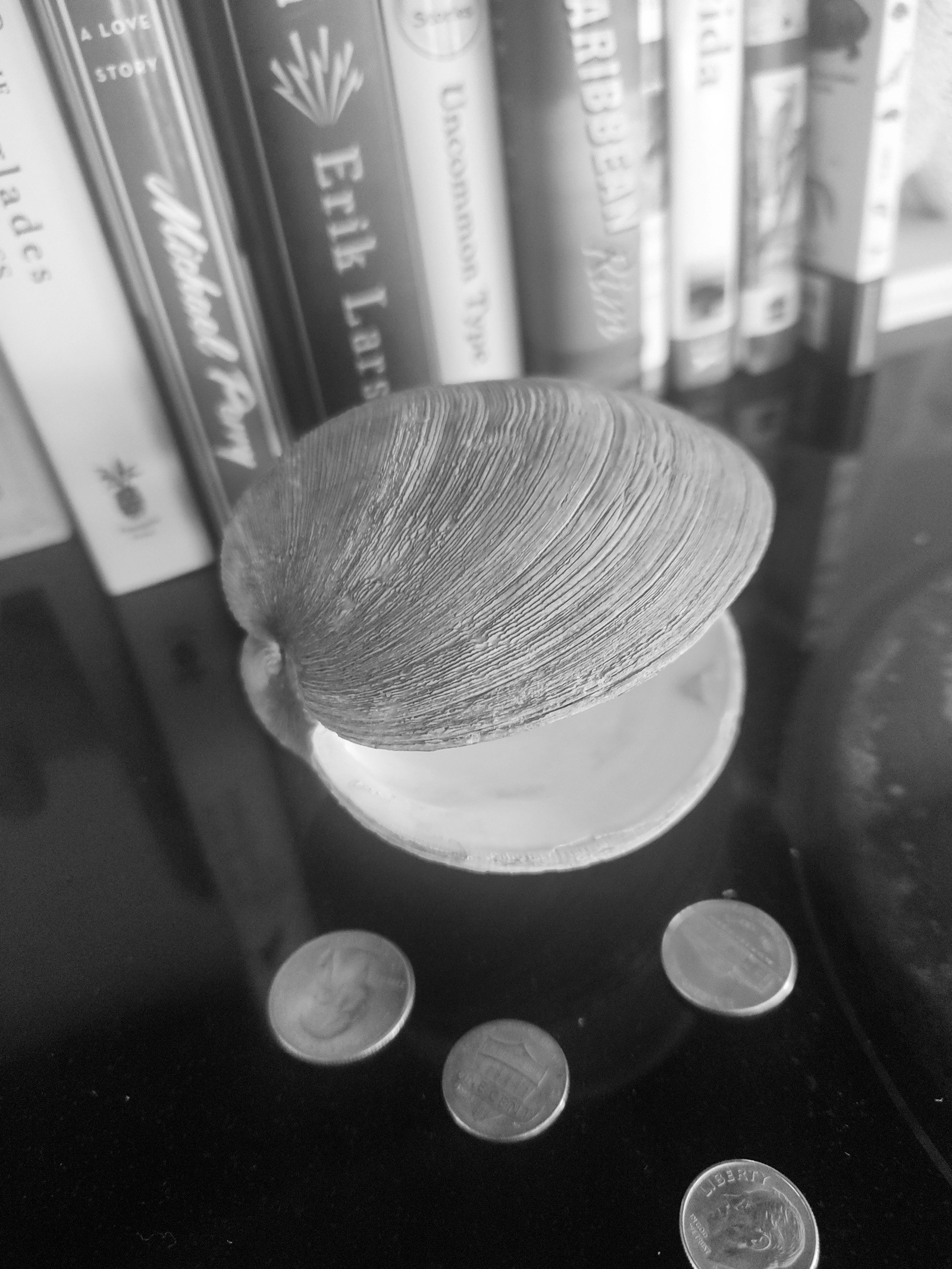
(Photo provided)
I found it last winter while riding my bike on a dusty road in the Florida Everglades. It was a crushed-shell road, and I was surprised to find this whole unbroken shell one morning as if it had just fallen from the sky.
It is a full empty shell, larger than the palm of my hand, partly opened and still hinged at the back.
Thick, heavy, and as hard as a stone, I wonder if it might have been dropped there by a Florida snail kite, or some other bird that specializes in cleaning out clams and snails, leaving only the shell behind. Or maybe left behind by an otter, though I would think that an animal that strong would have cleaved the halves in two. Or could it simply have been brought there by a truck hauling a new load of shells to repair the road?
In any case, it was too beautiful a treasure to leave behind, so I took it home with me. It has sat on my shelf ever since. (I know, some people decorate their homes with pictures and pottery. I have turtle and clam shells, and an occasional snake skin.)
I often pick the shell up and turn it over in my hands, admiring its strength and also its subtlety. While its inner parts are as smooth as glass and as creamy as a pearl, its outer surface is rippled with rock-hard rings, as narrowly divided as a fingerprint.
But my curiosity finally got the better of me as I held it this morning. What kind of clam might it be? I fired up Mama Google (who knows everything) and asked her to tell me all things clammy.
I decided that it must be a quahog, a type of hard-shelled clam whose range runs from Nova Scotia through Florida. Judging by photos, my shell was about as quahoggy as it gets.
And that’s when Mama Google knocked my socks off, because it turns out that the tiny ridges on a quahog’s shell indicate how old the clam is, like rings in a tree. And my shell’s rings were virtually countless.
Well, they were countless by me, because my vision isn’t what it used to be. But I had to know: If each ring stands for a year of life, is it even possible for a clam to be that old?
Mama Google assured me that clams can live to a ripe old age, depending on species. Some kinds live only a year. Others for decades, and even centuries.
The eldest clam on record is known as Ming, an ocean quahog clam dredged alive off the coast of Iceland in 2006. Her rings and other research indicated that she was 507 years old at the time of capture.
And when I read that, I knew that I had to find a way to count my clam’s countless rings—well, countless until this morning, when I decided that the best way to tally the rings was to use a sewing needle. Starting at the hinge, where the rings were a bit wider for the first 10 years or so, I scraped the tip of the needle over the ridges. It made a satisfying click as it passed over each ridge.
According to the rings, it took my clam buddy ten years to reach the size of a dime. In ten more years, it was maybe the size of a quarter. It would have been at least 35 years old before it could cast a silver-dollar sized shadow.
On and on the rings went, with the shell growing longer, wider and taller with each click.
Before I reached the outer edge farthest from the hinge, I had gone through 167 clicks.
That meant that my clam was born no later than 1857—before the Civil War, when Lincoln was just a country rube lawyer from Illinois. Florida had been admitted to the union only 12 years earlier, the last of the Atlantic seaboard states to be included. In all, the United States had only 31 states at that time.
And every year since then, my clam buddy sat buried in silt, its two syphons drawing in water and microscopic food and expelling waste. According to Mama Google, he probably began life as a male but became female later in life, as hundreds of creatures in the natural world do, expelling as many as a million eggs per breeding season.
Year after year.
Decade after decade.
One century into the next.
Quietly attending to the all-consuming business of being alive, until — who knows how? — she (he? they?) ended up on a dusty Everglades shell road in East Naples.
She is on a shelf in my living room now, a prized guest in my home.
I take her down often and hold her in my hands, counting back with a fingernail between ridges, asking: “What was I doing when she was this size? Or this size?”
Ticking off the countless changes that life holds in store for any living thing in the world.
TR Kerth is the author of the book “Revenge of the Sardines.” Contact him at trkerth@yahoo.com