

With June drawing to a close, the theatrical fireworks are just getting started. But sometimes, you are looking for something more emotional. Counter-programing has always been a part of the studios’ business model. While the empty calories play on screen, the healthier options play next door. And never the same audience shall meet, or at least they thought. After Barbenheimer, the idea of mutually exclusive filmgoing experiences were a thing of the past. Savvy viewers note that this is just another case of the pendulum swinging back. I remember the late nineties and early two-thousands were chalked full of this mid-budget scrappy fare.
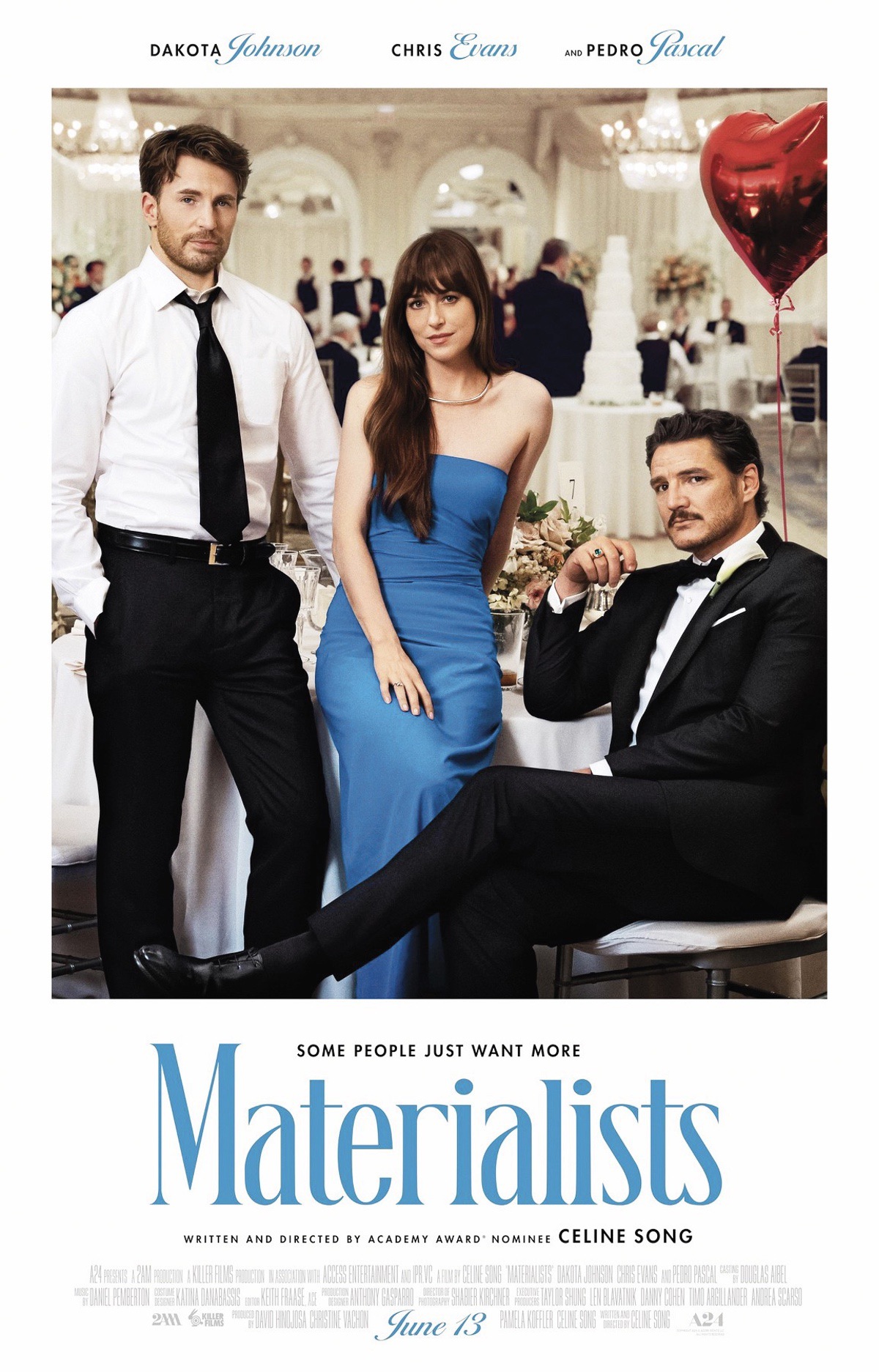
Materialists is the second feature of Celine Song, writer-director of the Oscar-nominated Past Lives (one of my favorites of 2023). While marketing might be deceiving, romantic drama is where this squarely hits. Song takes from her previous job as a matchmaker to create the world of New York and young professional Lucy. Song peers into the difficult task of pairing potential clients with eligible suitors.
Dakota Johnson is tailor-made for this role. Her world-weary vocal warble matched with her piercing side eye, something that years of working in indie film has helped her hone. But it wouldn’t work without equal matches. America’s hot dad of the moment, Pedro Pascal, has more charms than a Pandora shop and better riches to bestow on her. From the moment he enters the scene, the viewer is transfixed by his presence. However, there is this nagging pull towards the familiar. Enter Chris Evans’s John, Lucy’s former love who is a caterer and struggling actor. Setting both their attributes down on paper, it would seem that Pascal would be the obvious. Right? But as Lucy finds, data can’t answer the question of what makes love work?
Song is more into these inquiries of why we fall for the people we do and can we really boil it all down to some simple math. Six-feet tall, check; four figure job, no dice. Is love just a series of arbitrary values and rationale? Celine explores very compelling scenarios involving a rotating visual Rolodex of clients in cafes for Lucy to match. One standout performance is Zoë Winters’s Sophie who provides such a compelling story arc that she feels more like a co-lead than a supporting character. Much like her first feature, she introduces us to a few ideas only to turn them on their head by the time you each the end. I found myself tearing up and emotionally engaging here for each of them. Also, like Past Lives, there is no villain. In your typical rom-com, one beau would be revealed to be the worst for Lucy by his poor behavior. Not the case here; we are witnessing complex and sympathetic individuals who aren’t perfect. Even Lucy is extremely flawed which is refreshing to watch. Rooting for one couple over the other forces you to examine your own self-worth and value system. Song does create an ending but it is one that we need to interpret for ourselves. Sometimes we need to go with our gut over the heart or the head.
The Phoenician Scheme is the opposite of soulful subjectivity. Wes Anderson’s preoccupation with objects has, over the last number of films, migrated from the props and scenery. His characters have become living statues, and this is not praise. What follows is a tepid recommendation; I managed to chuckle and stay interested better than Asteroid City. But this isn’t saying much. Giving a synopsis would be a futile attempt at understanding what Wes is getting at. Gruff Father “A” wants to reconnect with Moody Daughter “B,” put together a plan that will ultimately not quite work out; crazy antics ensue. This plot worked with The Royal Tenenbaums. We miss you Gene Hackman. Benicio Del Toro is so much better than this. Scarlet Johansson and Tom Hanks, hope you got a good paycheck. Wes’s doll house has to recover its sense of play again.