
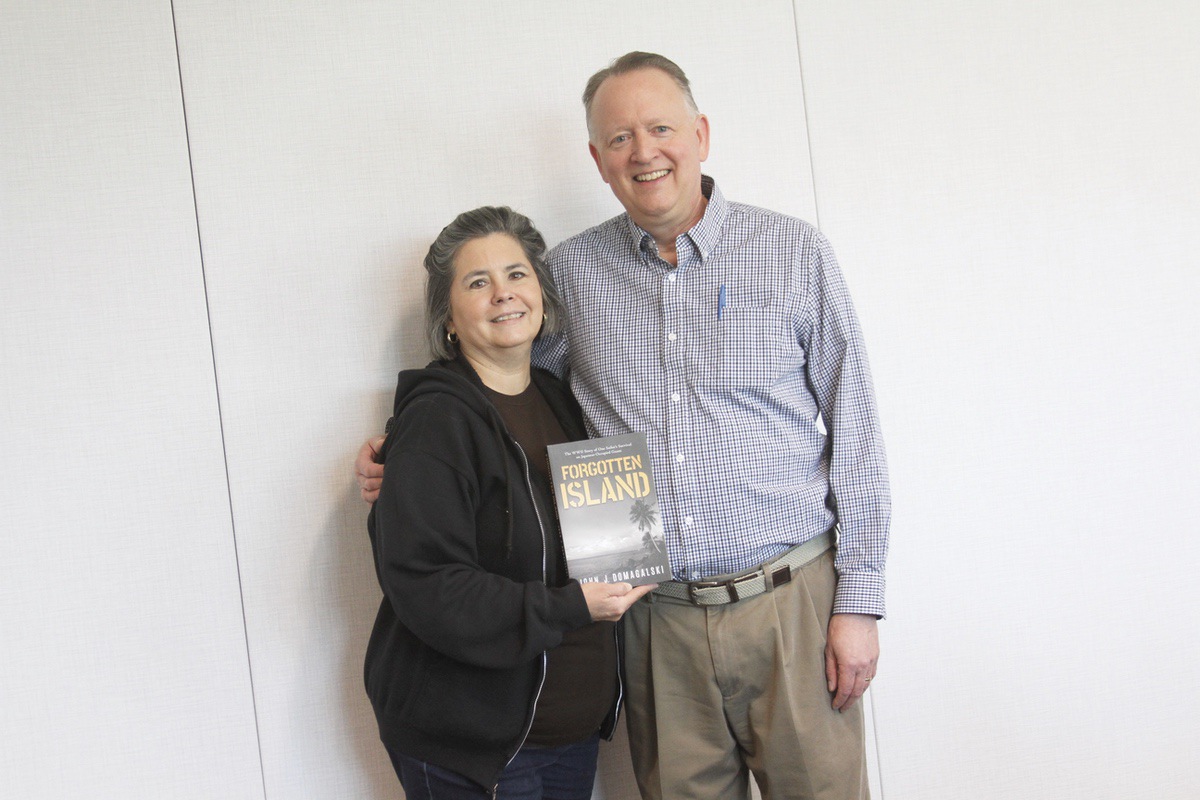
As a high school student at Huntley High School, John Domagalski had a couple of favorite subjects.
“I always enjoyed history and writing,” Domagalski said.
The Lake in the Hills resident, who works at Ace Hardware corporate offices, has taken his “hobby” and made it into a second career. His sixth book about World War II, “The Forgotten Island” was published last summer by Simon and Schuster. It is the story of Navy Radio Electrician George Tweed, who hid out on the island Guam from Japanese occupiers for two years and seven months. He described the writing the book and main character Tweed’s experiences at a Huntley Area Public Library session May 10.
“The Marinas Island chain is in the central Pacific and has been a United States possession since the Spanish-American War of 1898,” Domagalski said. “President William McKinley put it under the control of the Navy, and it had its own governor. It’s a sizeable island, about the size of Chicago. It has a very hot, humid climate and a lot of jungle vegetation.”
Tweed had been on Guam since 1939. As 1941 continued, the civilian population of US staff left, as it a US outpost and he knew any Japanese attack would come there early. It did, the day after the Dec. 7, 1941 Japanese attack at Pearl Harbor.
“The Japanese base at Saipan was only 117 miles away. There were only 155 Marines, 200 native islander force and 40 Navy personnel. The First Battle of Guam lasted just a few hours at Aguana, its capital,” the author said.
“Tweed received a Colt 45 pistol from the governor, then went to his 1926 car and headed to the southeast then hid the car and went to the jungle,” Domagalski said.
Six of those personnel, including Tweed, asked for and received permission to hide in the jungle rather than be Prisoners of War, the audience learned.
“Five of the six were found and killed, but Tweed was the only one who survived,” Domagalski said.
Tweed’s survival was in part due to luck and much assistance from the island residents. One of these was Antonio Artero, who provided Tweed’s final hideout in the last months.
“They did so at great personal risk,” Domagalski said. “If the Japanese found out they were assisting American fugitives, they would be shot. Tweed was always on the run from the Japanese, sometimes running for his life. One time, when he was hiding in a cave, he saw some writing on the cave which appeared to have been done in a hurry. After gathering his belongings, he went out about 50 yards and squatted in the bushes. One, two, then three soldiers walked by from where he had just been. All told, there was a group of 50 soldiers who walked by.
Tweed’s rescue by the destroyer USS McCall came on July 10, 1944, 11 days before the U.S. Invasion President Harry S. Truman approved a Legion of Merit with a “Combat V.”
“Tweed noticed that after the big ships had left, a few stayed behind,” Domagalski said. “With his background as a radioman, he was able to use a mirror to signal the ship. The sailors at first thought it was a Japanese gun position, but later learned it was Tweed. They went to the beach in the dark of night and rescued Tweed. He missed the liberation of Guam, and said it was his biggest regret.”
Tweed returned to Guam a year after the War, presenting Artero with a car he promised him. His ordeal was made into a movie, he was on Truth or Consequences show, and was known as “Ghost of Guam.” He went back to Oregon and owned a few businesses, in TV and radio repair. He died in a car accident in 1989.
Tweed was a long-time Naval officer, as he joined in 1922. He lived in Portland, Oregon and was 37-years-old when he reported to Guam.
The US invasion
According to a Wikipedia article, the United States Marines forces, after bombardment by B-29s, went ashore and the land portion of Operation Forager was launched July 21, 1944. Divisions assigned included the 3rd Marine Infantry; 77th Army Infantry, totaling 56,000 troops.
Naval Admiral Rufus King had secured the necessary resources for the Pacific Operation despite the “(defeat) Germany First” thoughts. The invasion began July 21, 1944. Guam was in US control in about three weeks but not before there were 1,568 deaths and 5,365 were wounded, according to a Wikipedia article.
Audience members praised the library program.
“I loved it,” audience member Charlotte Dehning of Huntley said of the talk. “My oldest brother, Christo Kosartes, served in the Navy on the ship Dickerson and received a Purple Heart.”
While John Domagalski wrote about World War II, his wife Sandy has military family ties. Her dad served at Saipan and Okinawa’s battles.
About Domagalski
Domagalski’s other World War II related books are: “Escape from Java”; “Under A Blood Red Sun”; “Battle of Kula Gulf”; “Into the Dark Water”; and “Lost at Guadacanal.”
Domagalski, who is an alum of Northern Illinois University and Huntley High School, may be reached at 847-669-1750; jdoma7@yahoo.com and www.pacificwarauthor.com.