
What makes for a good adaptation from the written word to a visual medium? This is a question that has launched many a film review in the past. Also, it has plagued filmmakers for over a century now. Most fall into two camps. Either you stay so completely faithful as to be a direct copy, think No Country for Old Men. Or you take the Baz Luhrmann approach, tossing every strange anachronism at the screen a la his Romeo + Juliet. Recent internet discourse has surrounded next year’s reinvention of Wuthering Heights. Although after watching the music video featuring Charli XCX with The Velvet Underground’s John Cale titled house, the Goth rock aesthetic has me intrigued in the soundtrack at least. As one commenter put it, Count Brat-cula indeed.
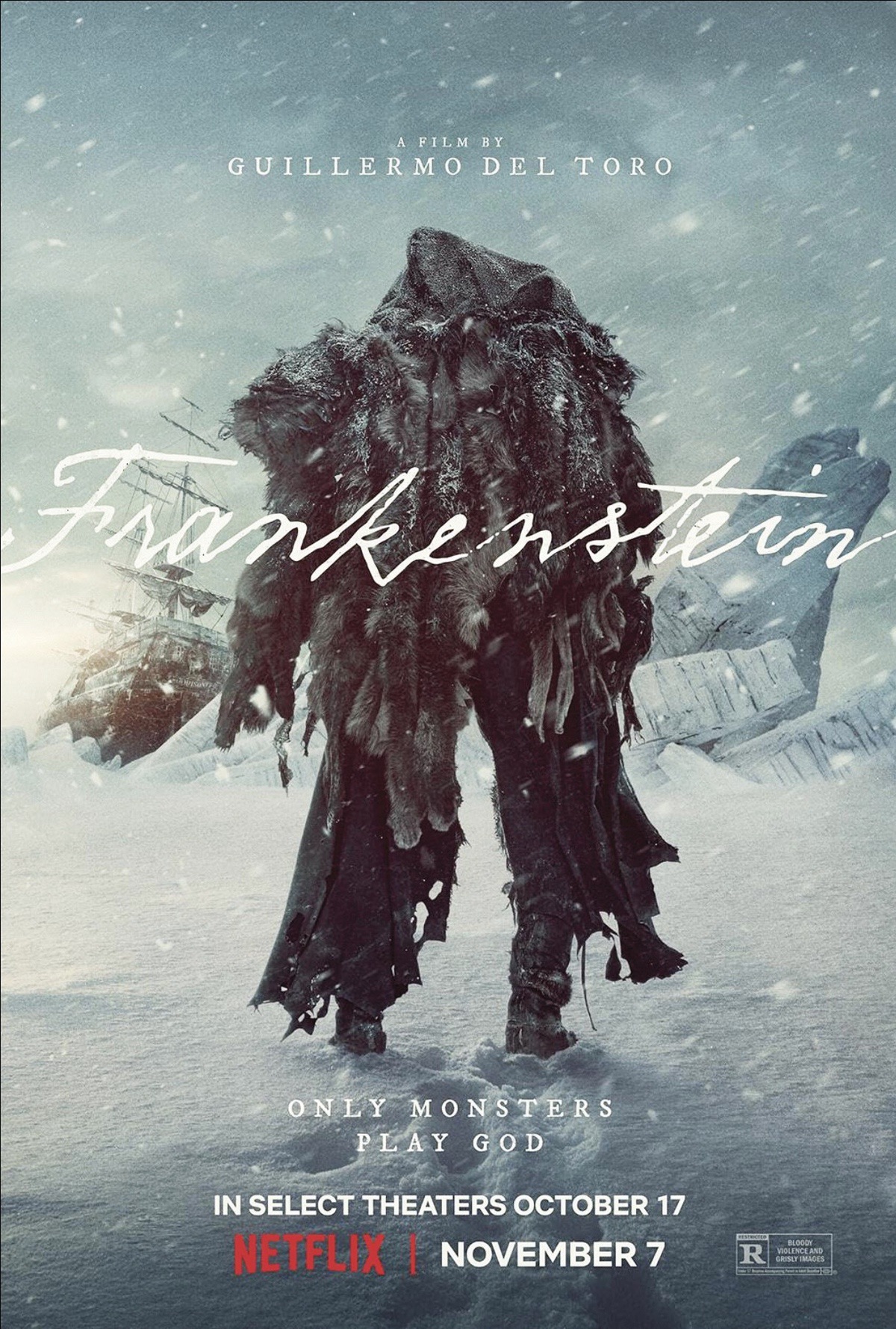
But I am getting ahead of myself. One of Heights’s stars, Jacob Elordi, has just made his star turn in Netflix’s Frankenstein. Another Gothic novel, Mary Shelley’s masterpiece is lovingly conceived by big-screen fabulist himself Guillermo del Toro. It has been many years since I read the original novel. However, del Toro’s script leaves the tale fairly intact through the two and a half hour run time. Despite that length, there is not a lack of energy throughout as we meet Victor (played by Oscar Isaac) left for dead on polar ice. The trapped ship and crew rescue him and Victor tells the captain his sad tale. Starting with childhood, he explains his obsession with conquering mortality. We see his progress in reanimating dead bodies, leading to his final experiment. The creation of the monster is the true centerpiece of the film, but here-on the second half takes over.
Elordi rules this part of the film, being brought into this new existence by unnatural means. The savage brutality of the actions are interrupted by more tender moments with Victor’s love Elizabeth and a blind man. Some have complained about his appearance, citing Boris Karlof’s visual design. This is to miss the mark as Shelley described him as sinewy and muscular, everything Jacob is. His patchwork skin, stitched from various corpses is a marvel of the makeup department. The sumptuous set design and costumes are par for the course in a del Toro production and will net Oscars next year. A crowd pleaser in every sense of the word.
Theater has always had a harder time translating in film without being stilted. Nia DiCosta’s Hedda shatters expectations by pulling the audience into Ibsen’s world, namely the soiree Mrs. Gabler hosts. The basic story remains but the frivolity is turned up to eleven. It was a hoot to go into this blind and let the visuals and story wash over me.
Tessa Thompson is a joy as our hedonistic heroine, pulling off one scheme after another with every interaction she makes. Her upturned smirk becomes a punctuation on any double entendre or snide comment. Her husband (Tom Bateman) tries to keep his in line, but to no avail. She is in complete control of the proceedings and I was happy to go along for the ride, drink in hand as a band plays. Nina Hoss plays his academic rival and Hedda’s former lover, one of the many twists to this tale that DiCosta pulls off. Also not stating the time period opens the play up for more modern commentary on the material.
The use of existing lighting and Sean Bobbitt’s cinematography gracefully sucks us into the party sequence as well as the quiet conversations at their margins. DiCosta knows when a good shaky handheld works for tension over a gliding tracking shot. One clever thought was to have Hedda glide with the camera when Hoss shows up, an homage to Spike Lee that brilliantly expresses her desire. With a jazzy score by Hilder Guðnadóttir, Hedda (on Prime Video) is an invite worth accepting.