
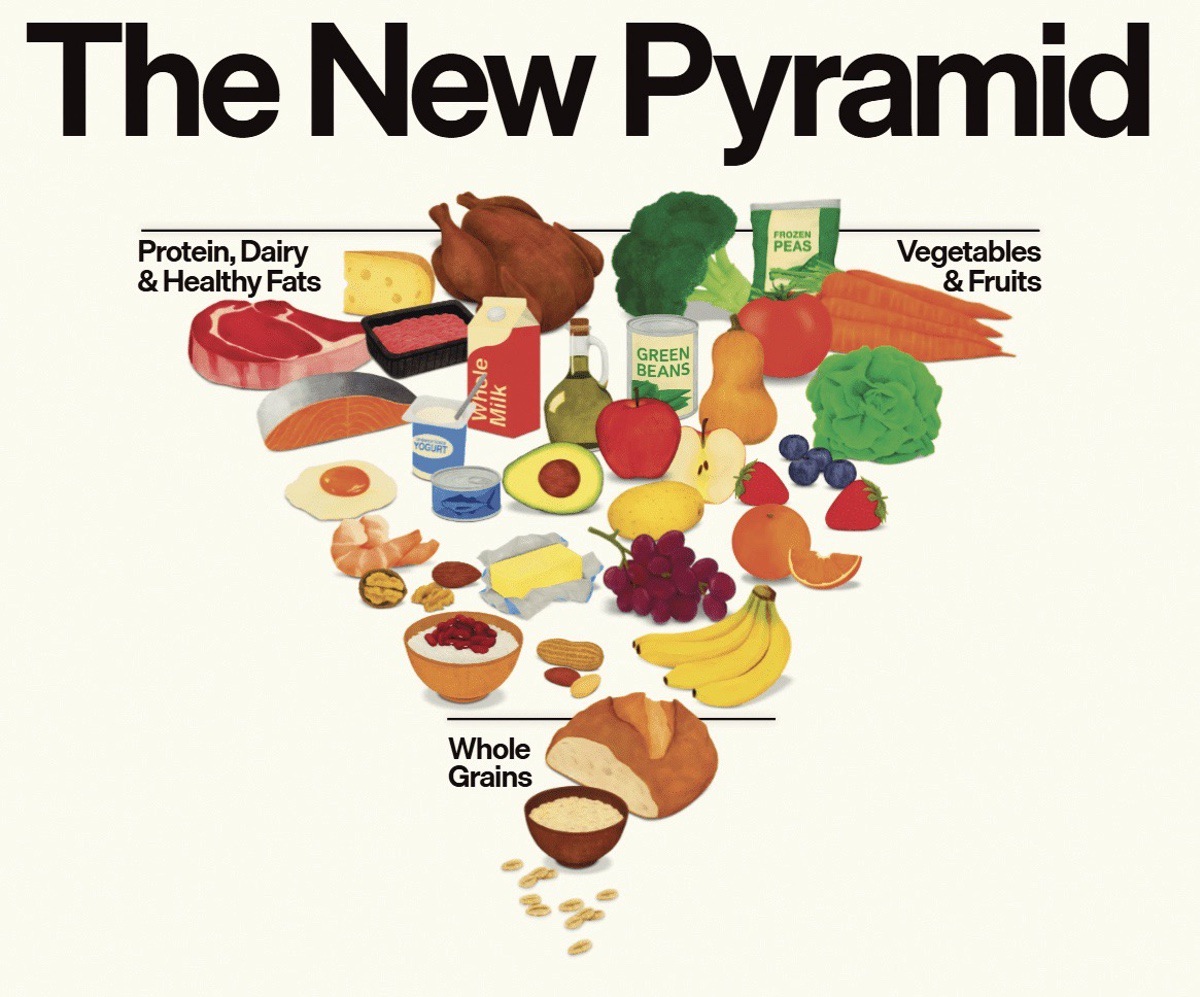
On January 7, the US Department of Agriculture (USDA)and the Department of Health and Human Services (HHS)released the 2025-2030 Dietary Guidelines for Americans (DGAs) with its revised visual model. This visual model upends the Food Pyramid in favor of meat and dairy. This has drawn strong criticism from experts and physician groups, saying the guidelines reflect agricultural and food industry lobbies rather than science. (Source: The 17,000 physician members of the Physician’ Committee for Responsible Medicine.)
Some positives
On the positive side, doctors and dietitians have noted the new guidelines emphasize fresh fruits and vegetables. The guidelines urge Americans to eat at least five servings a day (although most experts recommend even more nine servings.)
The new guidelines also recommend whole foods, such as whole grains; however, the visual model (new Food Pyramid) places whole grains at the bottom of the pyramid.
Also, these new guidelines are written for the layman with clear language, which has been hailed as a helpful step. Notably, advice calling for Americans to eat “real food” reflects an emphasis on meat and dairy over plant-based proteins.
Bottom line, the headlines called the new 2025-2030 Food Guidelines a mixed bag, reflecting both controversy and constructive advice. Reviewing the history of government dietary recommendations can help clarify.
Background of Dietary Guidelines for Americans
Way back in 1894, the USDA offered the first dietary guidance to Americans which has been updated regularly through the years. However, it was only in 1980 that the USDA and HHS combined and selected scientists from both agencies to work on the first Dietary Guidelines.
This Joint Coordinating Committee appointed a task force of scientists who established the DGA Advisory Committee which was tasked with providing the scientific framework for the DGAs. In 1990, Congress mandated that the DGAs would be published every five years so new research could keep the guidelines updated.
This year the process for the DGA 2025-2030 has been overhauled. For decades the Guidelines have incorporated the scientific report the DGA Advisory Committee reviewed over a period of 2 years. This year, a newly-created Advisory Committee with members with varying expertise was formed. It chose not to review the lengthy and comprehensive Advisory Committee’s scientific report, instead relying on brief reports of independent experts to form the 2025-2030 Dietary Guidelines.
Federal law requires this committee to be “fairly balanced in terms of points of view represented (to avoid) inappropriate influence by the appointing authority or any special interest,” traditionally resulting in a roughly equal mix of scientists and food industry experts. Critics have pointed out the present nine-member Advisory Committee is composed of seven members with ties to the National Cattlemen’s Beef Association, The Texas Beef Council, General Mills, the National Dairy Council, and the National Pork Board, creating potential bias towards meat and dairy.
Besides the potential bias towards meat and dairy and heightened emphasis on protein, the 2025-2030 DGA has raised other concerns as reflected here: “The American Society for Nutrition(ASN)supports the broad eating pattern in the newly released DGAs, 2025-2030,… (at)the same time, ASN is concerned that departing from the established scientific review process undermines confidence in the DGAs and nutrition science, contributes to confusion and distrust, and obscures the opportunity for meaningful scientific discourse.”
This concern highlights the need to understand the strengths and weaknesses of the new 2025-2030 Dietary Guidelines. These will be reviewed in the next edition.