On February 25 last year, the Sun City Board of Directors formalized a partnership between the Sun City Community Association and Huntley High School. This has initiative provided residents with a meaningful way to mentor local students and share their expertise. The collaboration was spearheaded by Dolores Fischer, a dedicated volunteer who recognized the potential for Sun City’s Charter clubs to support specific educational needs at the high school.
One of the first active projects involves Nicholas Wedoff from the school’s Career and Technical Education Department and the Sun City Model Railroad Charter Club. The groups are currently collaborating on a model of the Huntley Square project for the club’s permanent display. Additionally, students are manufacturing custom components for train cars using high-tech tools.
“We invited the club members to present to our engineering classes about the mechanics of train couplers,” Wedoff explained. “Our students are tasked with designing their own train cars, and they must create a unified design so that every car connects perfectly. Having experts come in for even a short presentation provides invaluable real-world perspective for our five engineering classes.”
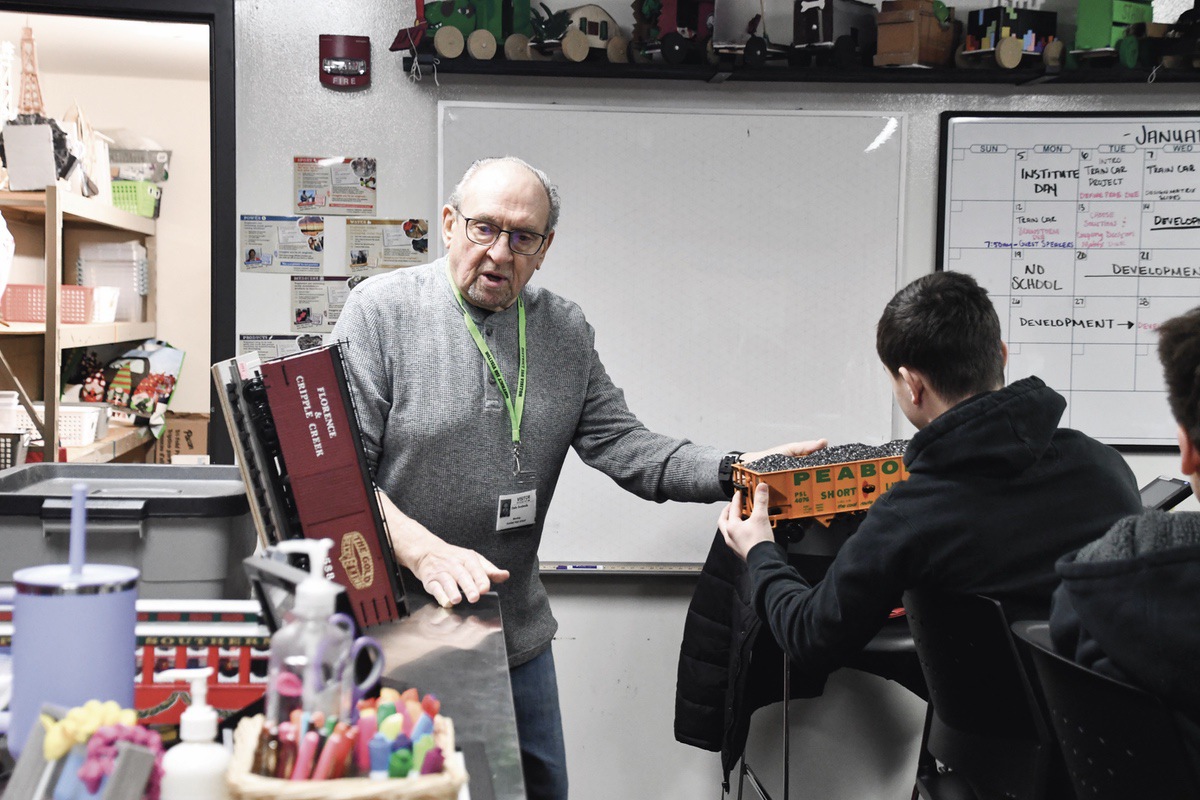
Dale Svoboda, President of the Kishwaukee Valley & Eakin Creek Model Railroad Club, along with members Paul Tamraz, Bernie Haniszewski, Bob Webb, and Maury Fisher, recently shared their expertise with local engineering students. The group brought various train scale examples to the classroom, offering firsthand knowledge of the hobby’s technical requirements. During the session, Svoboda demonstrated different train gauges and couplers, explaining the mechanics of how they connect.
Sun City Huntley hosts one of the few railroad clubs in the country operating layouts in all four major model scales: G, O, HO, and N. Their extensive facilities at the Millgrove Woodshop include a large outdoor G scale layout that traverses adjacent wetlands, while the lower-level houses detailed O, HO, and N scale systems.
Svoboda asked the students how many of them had a train set at home. A few of the students raised their hands.
“Most of our members’ first set that was very popular was the Lionel Train set. It was common to see one around the Christmas tree,” he said.
Early organizations played a key role during the Golden Age of Model Railroading from the 1920s to the 1950s. The hobby shifted from toy-based play to realistic engineering and accurate models. When national groups like the National Model Railroad Association (NMRA) formed in 1935, they set universal standards for scales and gauges. This ensured model compatibility and helped build a worldwide community of enthusiasts that remains active today.
Fisher, who knows about 3-D printing from his work in dental applications, said, “Replacement parts for our trains are not readily available; many needed parts are now made in Japan rather than the United States. Model train couplers are crucial for realistic operation, preventing derailments and ensuring smooth running. They require precision because even slight height mismatches or incompatible types can cause uncoupling, especially on curves or grades. Precision is crucial, requiring consistent height, proper shank length for improved slack action, and secure train assembly for realistic operation.”
Dolores Fischer, grateful for the Model Railroad Club members’ presentation, said, “Thank you for sharing your knowledge and passion for railroads with the engineering students. It was fascinating to learn about couplers, and having real train cars to examine brought the lesson to life. We truly appreciate the time, enthusiasm, and expertise you brought. It made for a memorable and inspiring experience.”
Nicholas Wedoff, Career and Technical Education Department, agreed.
“The presentation was exactly what we needed. Thank you all,” he said.
Students took in the information to help with their projects. Student Jedidiah Kondapall said, “The models were detailed and showed how the couplings were used on different models for different situations.”
Thomas Mitchell, along with other students, was appreciative of having samples of the gauges.
“I liked how we got to see examples of different train styles and how the couplings worked and interacted with each other,” he said.
Logan Drews agreed, “I didn’t realize that there were so many model sizes of trains. It was interesting to see the differences in couplers in the various scales.”
Student Zachary Hendricks summed up his experience.
“I found that looking at the models based on train design and the wheels and couplers was really helpful to understand how the system works,” he said.
If you are interested in volunteering, contact Dolores Fischer at doloresfischer@comcast.net.