

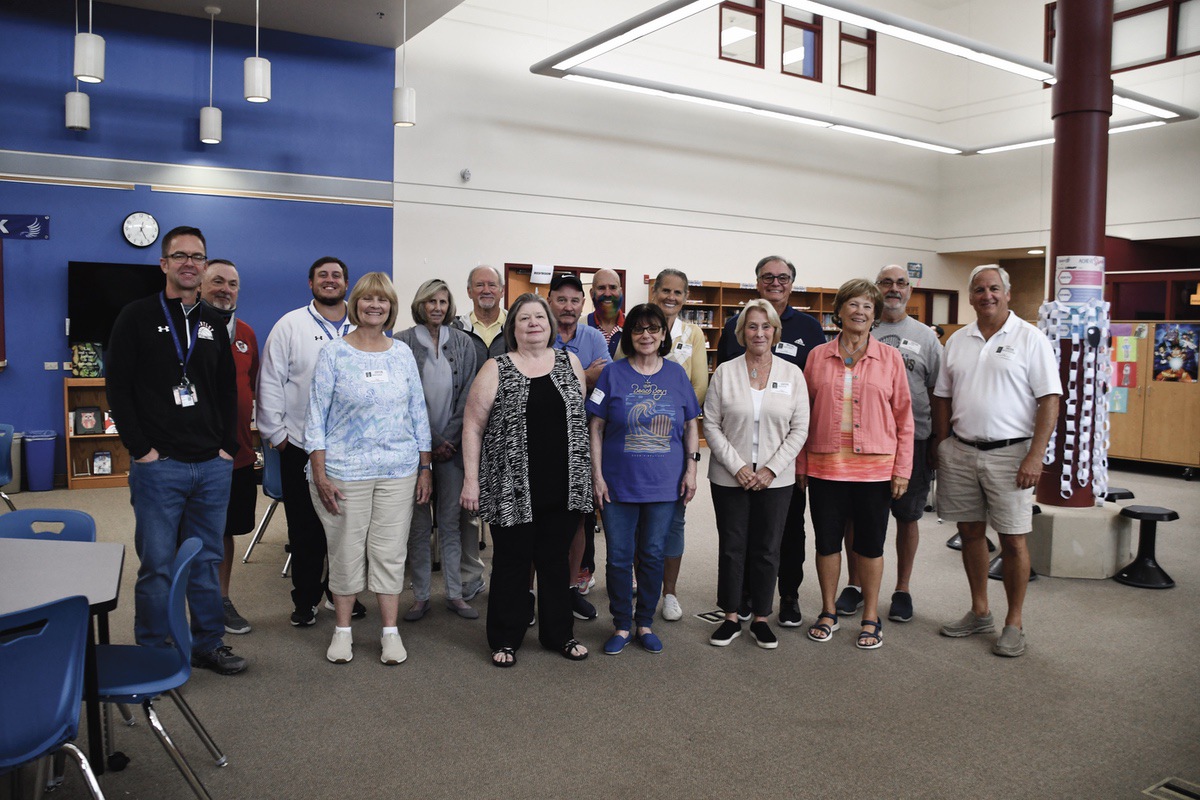
A group of Sun City residents accepted an invitation from Todd Ary, a Heineman Middle School teacher, to come and interact with eighth-grade students from his class and Justin Wolak’s class.
Pat Bosi, Pat Cox, Kenn Ellis, Duane Fontana, Todd Kane, Adrianne Kaplan, Jill McCarron, Bill Niemasz, Bob Olesen, Nedra Reeves, Alex Schank, Rita Schank, Mike Shortridge, Gayle Smolinsky, and Ken Such volunteered their time and spent two days at the school, where students interviewed them.
Ary wrote to the volunteers, “You have an opportunity to ‘bridge the gap’ from your generation to the current young eighth graders at Heineman Middle School, share your story and have some fun”
Students asked a variety of questions about residents’ personal details, childhood and family life, school and jobs, trends, and their views on current events, economics, and the impact of technology.
Bosi said, “It was a rewarding experience not only for the students, seeing what it was like in ‘the old days,’ but also a walk down memory lane for me personally. It was surprising how comfortable it was talking about my childhood to today’s 13-year-old, who is tied to electronics and an easier way of life. Still, I left thinking I had a wonderful, carefree childhood.”
Some questions asked were:
- What was your favorite music/band growing up that you would recommend I listen to?
- Since you grew up without cell phones or the internet, how did you communicate with your friends in town or in other states?
- Can you explain to me what a payphone was and how you used it? Busy signal?
- What kind of television shows or movies did you enjoy watching as a kid?
Rita Schank said, “I truly enjoyed the experience. The students were wonderful in their naïveté. My favorite question was ‘What is a pay phone?’ After describing its design and operating requirements, a pocket full of change, they somehow misunderstood and thought pay phones were in personal homes. I smile every time I think of that. The question that really took me back was in reference to the Kennedy assassination and how it affected the nation. I explained the general belief that the Kennedy White House was like Camelot. The immediate question from the students was ‘What is Camelot?'”
Each group of students compiled a report based on the residents’ responses and discussions. They were mailed out to each volunteer to enjoy.
Adrianne Kaplan said, “Upon my receipt of the reports the students put together, I dropped what I was doing, because I was so anxious to read them. I sat down and opened them up, crying and laughing. I love doing these interviews with the eighth graders. Some were accurate and some were a bit exaggerated, but it gave me a thrill and a sense of responsibility to teach the children about our past. Where we came from, what we had, the choices that were made for us, and a sense of responsibility to pass this information on to the students. They were all very kind to me and treated me with respect, both in person and in their reports. I would love to do this for as long as possible.”
The students had their own perspective on the interactions.
Naseeb Mann said, “When I asked my senior interviewee if she had any siblings and whether they got along, I was prepared for a simple, yes-or-no answer. What surprised me instead was the emotional depth of her story. My interviewee revealed that her mother had suffered multiple miscarriages, after having her first child, the interviewee herself. Thirteen years later, my interviewee’s little sister was born. She candidly shared that, growing up, the two did not get along very well, partly because she was tasked with babysitting her sister, forcing my interviewee to miss out on the typical teenage experiences like going on dates or spending time with friends. Yet, as she recounted, decades later, at 77 and 65 years old, the sisters finally found some common ground and a deep appreciation for one another. This story deeply resonated with me because it connects the past to the present in a powerful way. It illustrates the fact that relationships, especially those rooted in family, are shaped over time, often requiring patience, understanding, and the evolving perspectives that naturally come with age. Love is not always immediate, as sometimes it can take many years, decades even, to fully grow and flourish. Her story is a meaningful reminder to all that the bonds we form today may continue to transform, teaching lessons that echo across generations.”



1 Comment
Chris captured the wonderful interactions that took place with the students during our interview sessions at Heinman Middle School. The students were delightful and asked a variety of questions relating to our lives. I was amazed at their technology skills and their interest in my responses to their questions. In my teaching career, I had always worked with young elementary students. I didn’t know what to expect from middle school students but I was very impressed with their maturity, ability to ask quality questions and level of respect. Overall, this history project was a wonderful learning experience for me and one I would readily participate in next year. Thank you, Todd, for letting me be a part of your project.