
When the crew of Apollo 7 beamed the first live television broadcast from an American spacecraft on October 14, 1968, history was made. Millions of viewers watched as astronauts Wally Schirra, Donn Eisele, and Walter Cunningham floated in microgravity, holding up a handwritten card reading: “From the lovely Apollo room high above everything.”
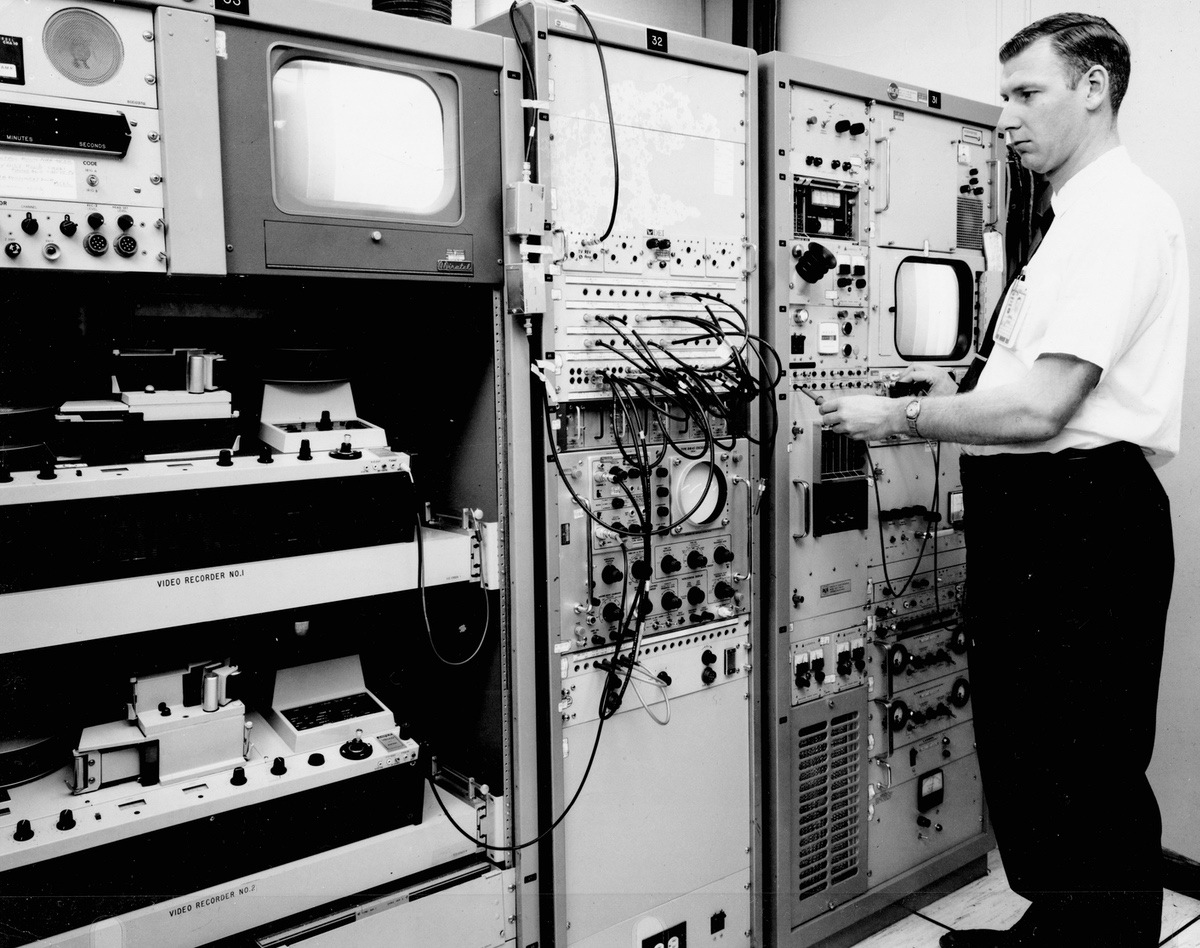
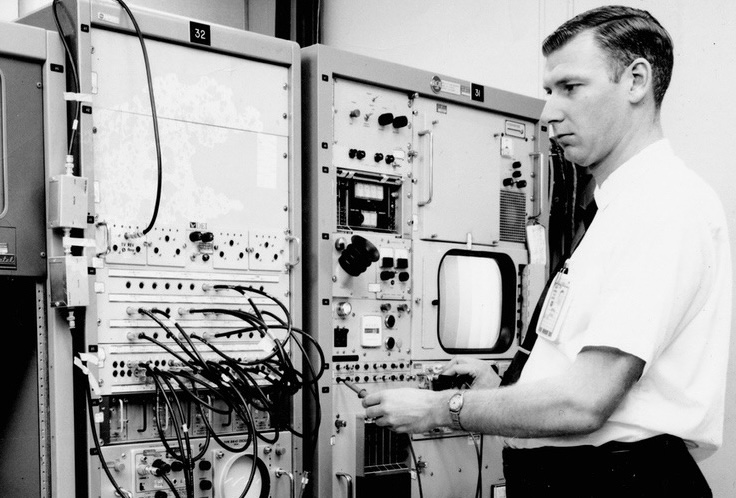
Working as a GE Contractor, George Gawell operates controls of Apollo-era NASA technology for the Apollo 7 broadcast from space on October 14, 1968. (Photo provided)
It was a public relations triumph for NASA. But behind that broadcast was an invisible army of engineers fighting a silent war against electrical physics at Cape Kennedy. Among them was General Electric (GE) contractor Sun City resident George Gawell, operating from a highly restricted room that few outside the space program ever knew existed.
Gawell, while working for GE in Florida, also played on a baseball team.
“One of my teammates asked me one day if I would like to help with the work at NASA. I said yes,” he said.
The challenge of broadcasting live from space in 1968 was a technological nightmare. To save weight, the RCA camera aboard Apollo 7 broadcasted in a primitive Slow-Scan format. Commercial television networks like CBS and NBC ran on standard National Television System Committee (NTSC) formats. The two formats were completely incompatible.
Gawell said, “To bridge the gap, ground signals had to pass through a specialized sub facility inside the Manned Spacecraft Operations Building (MSOB) known as CURFCOE — the Common Use RF Checkout Equipment hub. It was here, surrounded by banks of monitors and tangled cables, that I worked with a giant patch panel, routing the delicate, incoming deep-space radio frequencies.”
“My primary tool was the sync separator,” he said. “In television engineering, a picture is painted line by line, split into horizontal and vertical video signals. The sync separator’s job was to strip away the visual picture information, isolate the hidden timing pulses, and keep the imagery perfectly anchored. If those horizontal and vertical signals fell out of sync by even a microsecond, the historic broadcast from orbit would instantly be nothing but blur.”
For Gawell, the hours of routing signals evaporated the moment the hardware succeeded.
“My favorite memory of the entire program was the quiet magic of watching the signal stabilize, revealing the astronauts moving on the television monitor—live from space,” he said.
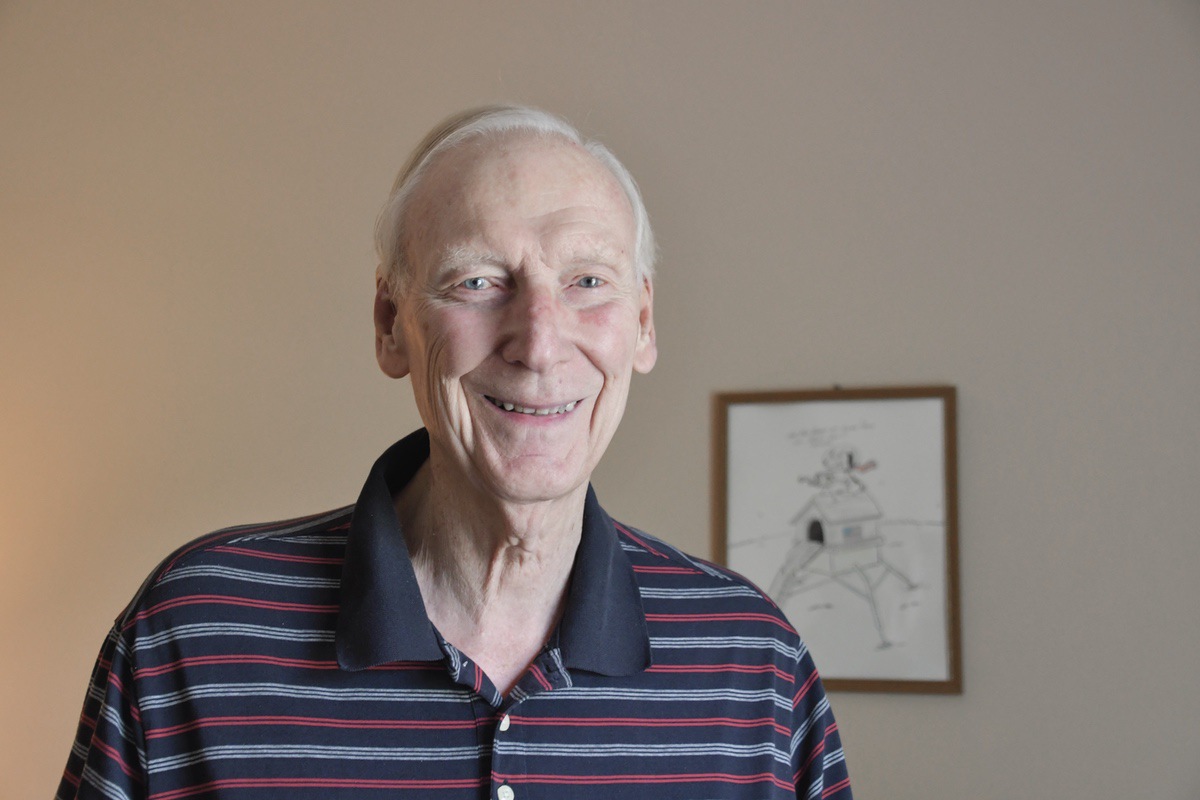
In 1968, George Gawell helped bring the famous Apollo 7 broadcast to life. (Photo by Christine Such/My Sun Day News)
Gawell’s role wasn’t just about operating equipment during a flight; it was about the bench-testing required to get the hardware ready for the next rocket. Because NASA was sprinting to meet an end-of-the-decade lunar deadline, ground teams immediately rolled into preparation for the next mission the moment a capsule left the launchpad.
During a high-stakes, around-the-clock November crunch period preparing ground-support networks for the upcoming Apollo 8 flight schedule, a piece of Bendix-built circuit hardware meant for the tracking and telemetry infrastructure did not function. Left in the corner of a test lab, automated checkouts had completely failed to diagnose why the unit remained dead.
Gawell said, “I relied on old-fashioned engineering intuition. Early digital logic circuits of the era ran on a universal five-volt standard, I realized there was a fundamental electrical conflict on the power rails. I manually switched the polarity, inverting a faulty plus five-volt input feed down to the required minus five-volt rail. The circuit instantly surged to life, clearing a major hurdle for the flight network.”
The engineering foundation established by Gawell and his peers during the flight of Apollo 7 paved the way for the most iconic television events in human history. Apollo 8 (December 1968) transmitted the first live television broadcast from lunar orbit, featuring the crew reading from the Book of Genesis on Christmas Eve. Apollo 11 (July 1969) transmitted the first live television broadcast from the actual surface of the Moon during Neil Armstrong’s historic lunar walk.
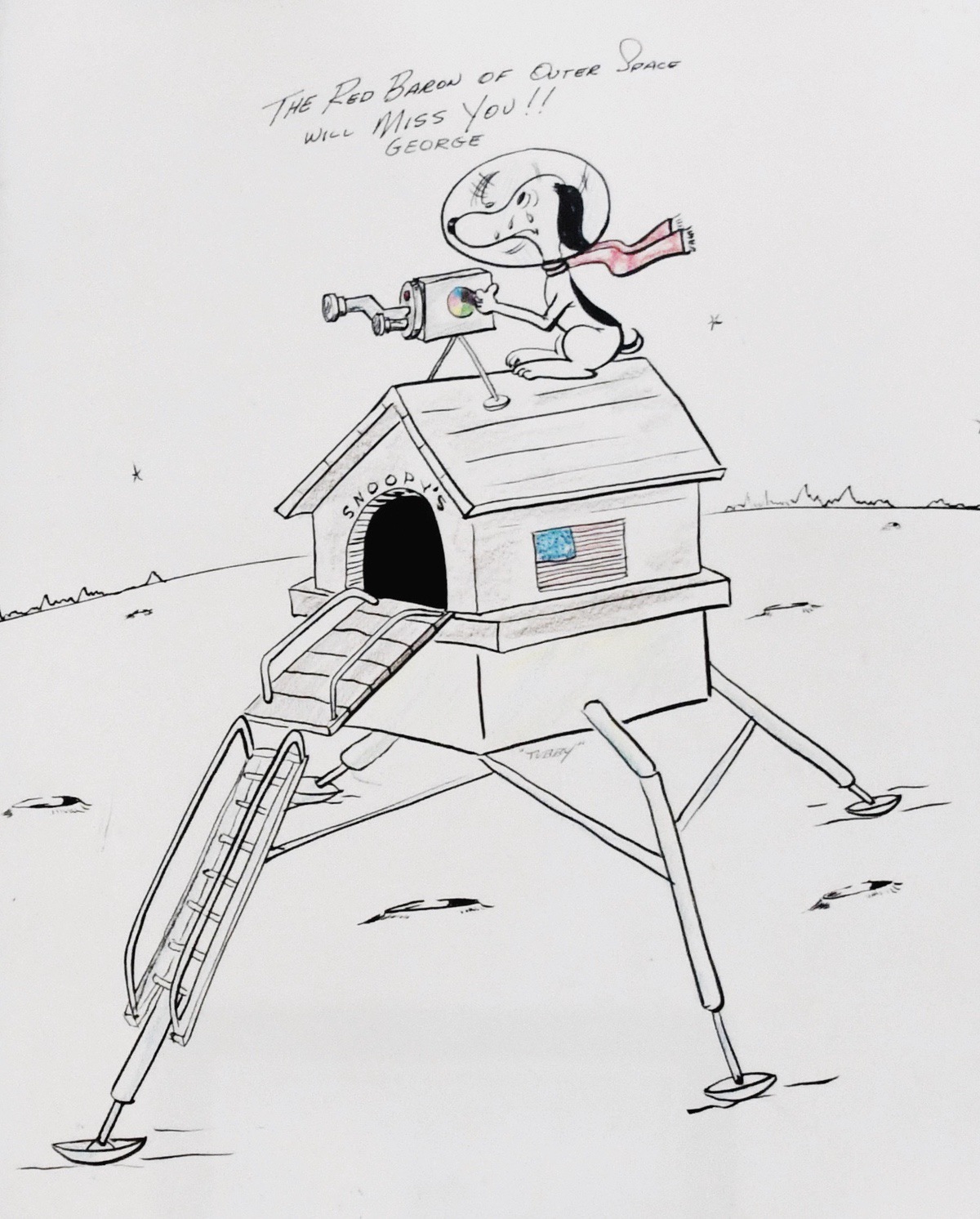
After Apollo 11, Gawell concluded his work at Cape Kennedy and was given this personalized Peanuts cartoon as a parting gift.
Gawell’s expertise eventually placed him in the room with the era’s historical figures. Following the monumental success of the Apollo 11 lunar landing in 1969, former President Lyndon B. Johnson visited the Cape Kennedy installations to honor the workforce.
Gawell said, “When I was given the rare opportunity to face the former Commander-in-Chief, I told him It is an honor to meet you, Mr. President. Johnson shook my hand and said the real honor is to meet you.”
The apex of the Apollo program brought an abrupt and difficult end to the golden age of Cape Kennedy’s workforce. Immediately following the success of Apollo 11, the program began to wind down.
Gawell said, “Federal budget cuts slashed the contractor personnel network at the cape from a peak of nearly 30,000 workers down to just 20,000. I was included in the massive layoffs.”
As Gawell prepared to say goodbye to the Cape Kennedy installations, his team gave him a unique parting gift: a framed, personalized cartoon of Peanuts character Snoopy. Outfitted in an astronaut helmet, Snoopy is depicted sitting on his doghouse. It was resting on lunar lander legs on the surface of the Moon—operating a TV broadcast camera. At the top, the crew inscribed a message that perfectly captured the camaraderie of the control rooms: “The Red Baron of Outer Space will miss you!! George.”