
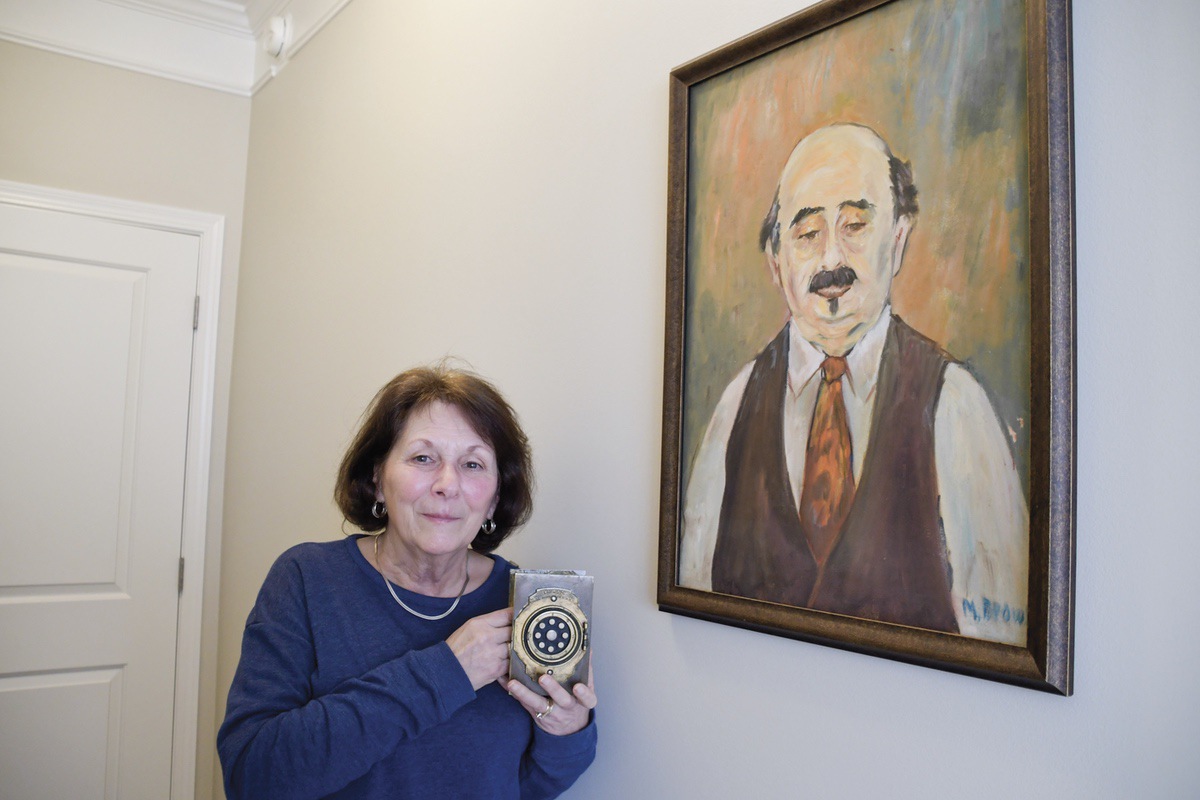
For Sun City resident Pat Janiga, family history isn’t just found in old photo albums; it’s built into the very frame of almost every home in America.
Janiga is the granddaughter of Edmond Michel, the visionary inventor who revolutionized the construction industry with the creation of the first portable electric handsaw. Janiga lovingly refers to him as “Pepere.”
Janiga said, “My grandfather came from a wealthy family. He was born on a train in France in 1886. He was a cojoined twin; his brother died at birth. He lived his entire life with one kidney. My grandfather graduated from Sorbonne University with degrees in Engineering and Art. He moved to the United States in 1907, settling in New Orleans.”
Early in his career, Michel patented tools such as the rotary hand-planer in 1918 and later invented a power-driven plane.
Watching sugar cane workers gave Michel the idea to create a motorized machete. In 1923, he attached a circular blade to a wooden frame and used a motor from a malted milk mixer. He later improved this invention into the world’s first electric handsaw.
Janiga said, “His invention caught the attention of Joseph W. Sullivan. He read about my grandfather in the New Orleans newspaper. After meeting with Sullivan, he moved to Chicago, and with Sullivan, they founded the Michel Electric Handsaw Company in 1924. In 1926, the company was renamed SKILSAW Inc.”
The name became so well-known that people now use it to refer to any handheld circular saw. In 1937, the Model 77 was introduced and became known as “the saw that built America.” Michel’s technology served an important role in World War II. The company created a special version of the saw, the PS-12, with a 12-inch worm drive and an air-powered motor that could operate in tough conditions, even underwater, for the U.S. Navy.
This invention let workers bring the tool to the wood instead of moving heavy materials to a fixed saw. That boost in productivity helped drive the housing booms of the mid-1900s. Even now, 100 years later, it is still the industry standard.
Janiga said, “Pepere decided to sell his rights to SKIL Corporation for $100,000 in 1925, which was an incredible amount of money at that time. He invested all his money in real estate in New Orleans near the French Quarter. Being deeply religious, he would not remove any tenants or require rent payment from them, and unfortunately, he lost it all in the crash.”
Michel was also a talented artist who restored artwork for museums in New Orleans.
“My grandfather did a lot of odd jobs, always working, doing even upholstery. He was always tinkering in the basement,” Janiga said.
Some of his inventions stayed somewhat hidden.
“My Pepere developed the Larmloc, which never took off. It was a push-button security lock. I have a book of his shares that he was selling for the invention, but the world wasn’t ready for it. My family used his prototype on our own front door for years.” Janiga still has that prototype.